Destination Rating: ⭑⭑⭑⭑⭑
Vegan Friendly Rating: ⭑✩✩✩✩

Located on Victoria Island in Canada’s High Arctic, Cambridge Bay is one of those places where the landscape, climate and logistics are a reminder of just how vast and remote Canada really is. There are no towering forests, no lush fields and very little vegetation beyond grasses, mosses and hardy Arctic plants. With only a short summer season, the landscape is predominantly tundra.
And for vegan travellers, visiting Cambridge Bay requires a little more planning than your average city getaway.
Another option to visit Cambridge Bay would be to take an expedition cruise as it is a stop on many for the Northern Passage Route.
Welcome to the High Arctic
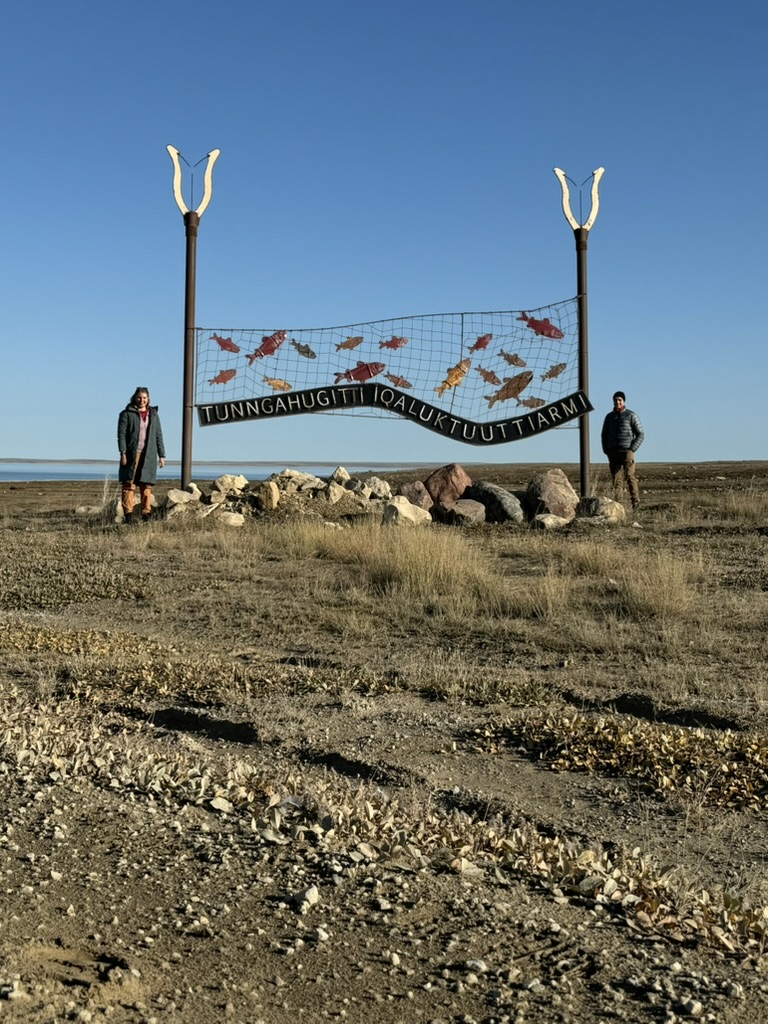
Cambridge Bay—known in Inuinnaqtun as Ikaluktutiak, meaning “good fishing place”—is the administrative and transportation hub of the Kitikmeot region of Nunavut. It sits on the southeast coast of Victoria Island, well above the Arctic Circle.
One of the first things you notice is the lack of trees.
With such a short growing season and harsh Arctic climate, the landscape is almost entirely tundra. The summers can bring surprisingly mild days, but winter temperatures can plunge dramatically, with January average highs around -30°C.
I remember looking across the landscape and thinking just how different it was from the forests and mountains of British Columbia. It’s stark, expansive and incredibly beautiful in its own way.
And then there is the light. During the summer, Cambridge Bay experiences extraordinarily long daylight hours, creating an almost surreal feeling as you explore the landscape.
Home of the Canadian High Arctic Research Station
Cambridge Bay is also home to the Canadian High Arctic Research Station (CHARS), a state-of-the-art research campus operated by Polar Knowledge Canada.
The station supports research into Arctic ecosystems, environmental change, technology and other areas of polar science. It was designed not only as a research facility but also as a place for knowledge sharing and community engagement.
For visitors interested in climate, science and the future of the Arctic, CHARS adds another fascinating dimension to a visit.
The Arctic isn’t just somewhere to admire from a distance—it’s an important place for understanding our changing planet.

What is it like being vegan in Cambridge Bay?
This is where you need to plan ahead.
Cambridge Bay is a remote Arctic community, and food logistics are very different from what we’re accustomed to in southern Canada.
Most groceries need to travel a very long way to reach the community. Supplies arrive by sealift when possible, while other products are transported by air. That means grocery selection can be limited, availability can change and prices can be dramatically higher than what you might expect at home.
During my visit in 2024, I remember seeing a single can of refried beans priced at $7 CAD.
That certainly makes you rethink what you consider a pantry staple!
Because of this, we brought freeze-dried meals with us, which made things considerably easier.
My advice: pack your vegan staples
If you’re planning a trip to Cambridge Bay, don’t assume you’ll be able to walk into a grocery store and find all your favourite vegan foods.
Instead, think of the trip more like an expedition.
Consider bringing:
- Freeze-dried vegan meals
- Instant oatmeal
- Dried beans and lentils
- Rice or quinoa
- Pasta and sauce
- Protein bars
- Nuts and seeds
- Nut butter
- Vegan protein powder
- Dried fruit
- Dehydrated vegetables
- Crackers and other shelf-stable snacks
- Your favourite seasonings and sauces
If you’re staying somewhere with a kitchen, this gives you considerably more flexibility.
There are grocery stores in town, including Ikaluktutiak Co-op and Northern Store, but I would treat anything you find that works for your diet as a bonus rather than relying on being able to purchase specific vegan products.
And remember: availability changes. Something you find on the shelf one week may not be there the next.

Eating out as a vegan
Cambridge Bay does have restaurants and cafés, but this isn’t a destination where you’ll find a long list of dedicated vegan restaurants.
Kuugaq Café is one of the local dining options, while Saxifrage and Arctic Islands Lodge also provide meals in the community.
For vegan travellers, I recommend contacting restaurants before you arrive rather than assuming there will be a plant-based option available when you walk through the door.
Explain clearly that you don’t eat: meat, fish, poultry, eggs, dairy, butter or other animal products.
And don’t be afraid to ask what ingredients are actually used. Something that sounds plant-based on a menu may contain butter, dairy or other animal-derived ingredients.
For a destination this remote, a little advance communication can make a huge difference.

Experience the Arctic landscape
The real reason to visit Cambridge Bay isn’t the vegan food scene—it’s the Arctic itself.
One of the highlights is Ovayok Territorial Park, located outside the community. The park surrounds Uvajuq, also known as Mount Pelly, and offers hiking opportunities through the unique tundra landscape.
Keep your eyes open for Arctic wildlife, including muskoxen, and take the time to appreciate just how vast and untouched the landscape feels.
Cambridge Bay is also an important place for experiencing the history and culture of the region. Archaeological sites around the community tell stories of Inuit life and earlier exploration, while the local heritage organizations provide opportunities to learn more about Inuinnait culture and history.

A destination for curious travellers
Cambridge Bay isn’t necessarily a destination I’d recommend for someone looking for an easy vegan holiday.
But for the adventure traveller who wants to experience somewhere genuinely different, it’s extraordinary.
This is a place where you become much more aware of logistics.
Where your food has travelled hundreds—or thousands—of kilometres.
Where a grocery store can feel like a lifeline.
Where there are no trees on the horizon.
Where the landscape stretches seemingly forever.
And where the experience of simply being there can be just as memorable as the activities themselves.
My vegan travel tip
Pack more food than you think you’ll need.
When travelling somewhere this remote, I would much rather come home with a few extra freeze-dried meals than find myself wishing I had packed more.
And remember that travelling vegan in remote communities requires a different mindset.
The goal isn’t necessarily to recreate the exact vegan experience you would have at home.
It’s about being prepared, flexible and respectful of the realities of the community you’re visiting.
For me, that is part of what makes travel so rewarding.
Cambridge Bay may not be the easiest place in Canada to travel vegan—but it is certainly one of the most unforgettable.
Vegan Guide
